

Not all great things come from this earth, and moissanite is proof. Discovered in 1893 inside a meteorite crater in Arizona, this rare silicon carbide crystal captivated scientists before it ever caught the eye of a jeweler. Over a century later, it's one of the most sought-after gemstones in fine jewelry because of what it is on its own terms: brilliant, durable, and built to last.
History
Moissanite was first discovered in 1893 by Dr. Henri Moissan, the French scientist after whom the gemstone was named. He discovered the microscopic particles in an Arizonan crater that was created by a meteorite.
Initially mistaken for diamonds, they were later identified as crystals made up of silicon carbide: a compound so rare in nature that today’s moissanite stones are mostly lab-created.
Manufacturing
It wasn’t until the late 90’s that scientists figured out how to create moissanite.
Moissanites are man-made gems, made up of silicon carbide crystals. These crystals are then fashioned together into moissanite gemstones.
Creating a single moissanite stone takes two to three months. Scientists grow silicon carbide crystals under controlled conditions, then cut and fashion them into finished gemstones. All moissanite rings at Afandi 4mm and larger come with a Limited Lifetime Warranty covering defects in material and workmanship.
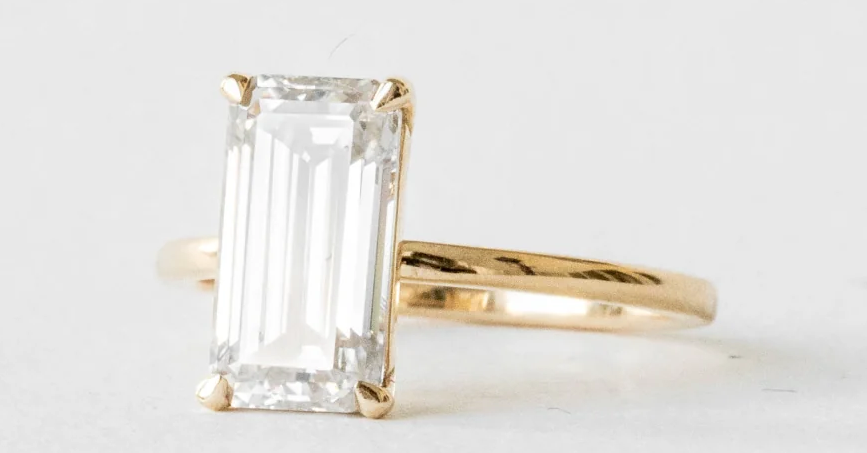
Attributes of Moissanite
Brilliance
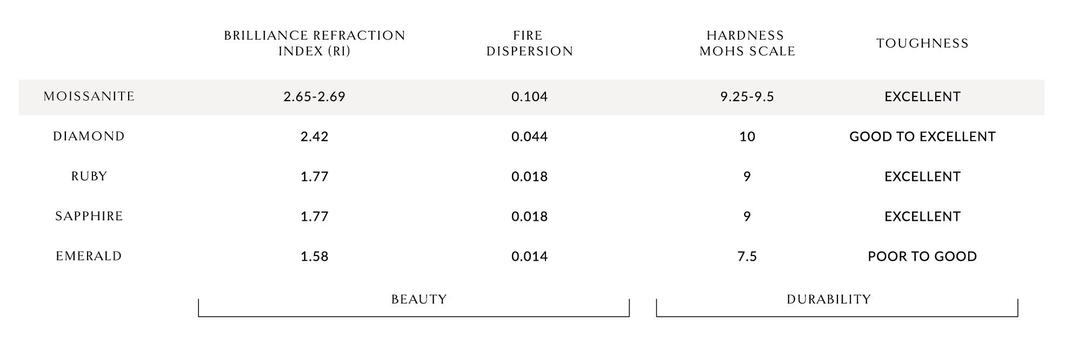
Moissanite's refractive index ranges from 2.65–2.69, outperforming diamond (2.42) and every other popular gemstone. That means more light return, more sparkle, and a stone that earns attention in any setting.
Fire Dispersion
A gemstone has a property called dispersion, the prism effect that occurs when pure white light enters a non-opaque object, breaks into spectral (rainbow) colors, and reflects to the viewer. Dispersion is used to measure these reflective properties, a gemstone's "fire." Moissanite’s dispersion is 0.104, which exceeds that of any gemstone, including diamond, ruby, sapphire, and emerald. In the right light, it doesn't just shine. It performs.
Hardness & Toughness
Moissanite is durable, tough, and extremely resistant to scratching and abrasion. With a hardness of 9.25-9.50, moissanite is harder than all other gemstones except diamond.
Moissanite exhibits more heat resistance than many other gemstones, including diamond. Tests show that at 2,000ºF higher than the equivalent intensity of a house fire, moissanite gems remain intact and as brilliant as the day they were created. This heat tolerance makes moissanite unlikely to suffer damage during jewelry repair.
Why Moissanite?
It's Popularity in Jewelry
Moissanite is becoming increasingly popular in engagement rings and other fine jewelry due to its affordability, durability, and stunning appearance. It provides a high-end look without the high-end price tag. Born from a meteorite and refined by science, it outperforms nearly every gemstone in brilliance, fire, and durability. It wears beautifully, holds up over time, and carries a story worth telling. Whether you're shopping for an engagement ring or a piece you'll pass down, moissanite is fine jewelry that doesn't ask you to choose between quality and value.